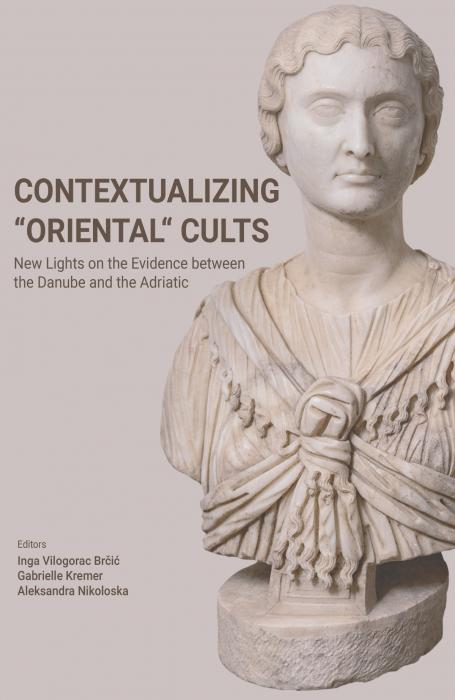
Contextualizing “Oriental” cults. New Lights on the Evidence between the Danube and the Adriatic
Synopsis
The Center for Interdisciplinary Research of Ancient History of the Institute of Croatian History at the Department of History, Faculty of Humanities and Social Sciences, University of Zagreb, initiated the international scientific symposium "Contextualizing 'Oriental' Cults. New Lights on the Evidence between the Danube and the Adriatic," held in Zagreb and Ptuj from September 15 to 17, 2022. The co-organizing institutions were the University of Toulouse Jean Jaurès, the Austrian Academy of Sciences, the Cultural Heritage Research Center "Cvetan Grozdanov" of the Macedonian Academy of Sciences and Arts, the Archaeological Museum in Zagreb, and the Regional Museum Ptuj – Ormož. The aims of the symposium were to explore and discuss how "Oriental" cults manifested in the Danubian and Balkan provinces, based on epigraphic and material evidence. Attention was given to the spread and development of these cults in various contexts – historical, political, topographical, civil, economic, and military. Presentations and discussions yielded valuable new insights and conclusions. The international character of the symposium, with participants from several countries (Croatia, Slovenia, Austria, France, Belgium, Luxembourg, Germany, North Macedonia, Greece, Hungary, and Romania), enabled an exceptionally cohesive and dynamic academic and cultural exchange. Two years after the symposium, we have gathered scientific contributions from most participants. The publication is intended for both the domestic and international scientific community, as it presents the latest findings and conclusions on the so-called "Oriental" cults.
Chapters
-
Acknowledgements
-
Editorial introduction: Contextualizing “Oriental” cults. New light on the evidence between the Danube and the Adriatic
-
Abbreviations
-
Introduction
-
“Oriental” deities in the urban context
-
Not only Mithras - Reflections on sanctuaries of the high and late Roman Empire on private ground, with particular consideration of Noricum and Pannonia
-
“Oriental” gods as a romanizing factor? A case study from the Danube Limes
-
Faustina the Younger, Isis, and the grain trade in Styberra
-
Iseum – a cohabitation: the micro-topographical and functional environment of the Isis sanctuary in Savaria in the 1st and 2nd centuries AD
-
Locating Dionysus at the Isiac sanctuary of Thessaloniki
-
Isiaca from the Roman cemeteries of Thessaloniki: the small finds
-
The presence of the sistrum in the Balkan and Danubian provinces of the Roman Empire
-
Cult of Mithras, slaves, portorium and salinae in Dacia
-
The mithraeum from Colonia Sarmizegetusa: on the limits of materiality of religion
-
Invicto Mithrae spelaeum fecit: Mithraic temples in the Roman province of Dalmatia
-
Monuments dedicated to Leo and Fons from Golubić (Bosnia and Herzegovina). A specific form of worship of Mithras’ cult?
-
Mithras and the imperial cult
-
Mater deum Idaeae and the imperial cult in Latin inscriptions
-
Cults of Anatolian local gods in Moesia Superior through the eyes of their worshippers
-
Epigraphic testimonies of Jupiter Dolichenus: iatric aspects
Downloads
Downloads
Published
Categories
License

This work is licensed under a Creative Commons Attribution-NonCommercial-NoDerivatives 4.0 International License.